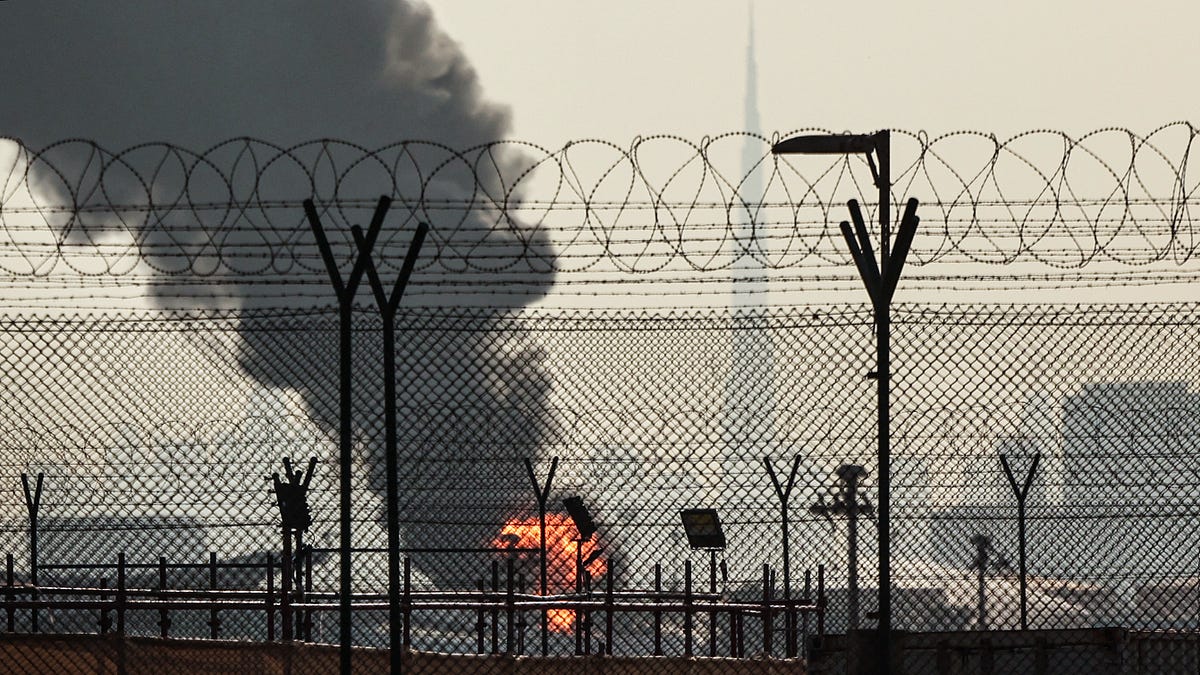
That's not stable source because of regional war with Iran as Iran can destabilize and destroy the economy in Gulf states, so they would end up to scrap the funds that need to spent on infrastructure repairs or replacement that is damaged or destroyed by war.
The bad news wouldn't felt until several months later from now.
@Moe Interestingly, a little after that article was published, the WSJ also had another article on the war's potential long-term effects on Saudi Arabia:
"Vast development sites around Riyadh trumpet images of a shiny new future for Saudi Arabia—part of Crown Prince Mohammed bin Salman’s grandiose Vision 2030 agenda to turn the petrostate into an international hub of trade, technology and culture.
Appeals for investment are sprinkled on ubiquitous construction fencing, along with English-language catchphrases such as “redefining livability” and “an extraordinary new normal.” Mohammed’s vision extended to a pledge to invest up to $1 trillion in the U.S. during a landmark visit to the White House in November, earning him praise from President Trump. The warm embrace was a signal that the de facto Saudi leader, once shunned in the West, was fully rehabilitated on the world stage.
Yet those extraordinary plans are slamming into reality. Over the past year, the world’s largest oil exporter began pulling back on many of its promised projects and investments, met with budget shortfalls and unrealistic designs. And now the U.S. and Israeli war with Iran has plunged Mohammed’s sweeping vision deeper into jeopardy.
Iran’s closure of the Strait of Hormuz has limited Saudi oil exports to about half their normal capacity. The kingdom has shut down most of its offshore fields and this week stopped operating one of the world’s largest petrochemical plants.
The war has already cost Saudi Arabia more than $10 billion in lost revenues and expenses, people familiar with the matter say. The Saudi government didn’t respond to requests for comment.
Nearly every mega-project unveiled as part of Vision 2030 is now under review, a process that predates the war, people familiar with the matter say. Officials are also reconsidering the size of U.S. investments pledged last year, the people said.
The $1 trillion Saudi sovereign-wealth fund, the Public Investment Fund, yanked back spending and hiring in numerous areas and sold much of its U.S. stock portfolio, even before the war. In December, PIF pleaded with wealthy families, fund managers and local businesses to pump more money into Saudi projects, people familiar with the matter said. Government departments were told to tighten their belts, reduce travel and stay in cheaper hotels abroad.
Mohammed is walking a thin line. He has quietly urged Washington to keep the war going until Iran’s ability to project power has been degraded, The Wall Street Journal has reported. But he also doesn’t want the war to engulf more energy infrastructure. Officially, the government says it supports a peaceful resolution.
The stakes are high. Saudi Arabia is the Arab world’s largest economy and a source of global capital and investment.
The recent sharp rise in oil prices could help restore some lost revenues. Saudi Arabia is still exporting large volumes through a pipeline that carries oil to the Red Sea, bypassing Hormuz.
In the longer term, high oil prices risk pushing consumers into habits that slash their oil use, or could trigger a recession that hurts demand. The kingdom also faces the danger that Iranian-armed Houthi militants in Yemen, who halted traffic through the Red Sea during the war in Gaza, could block that route again. The Houthis attacked Israel last week, but so far haven’t targeted Saudi Arabia or Red Sea shipping lanes.
Saudi Arabia’s debt load soared to nearly $400 billion. While still quite conservative compared with Western states at 32% of GDP, it was well above the 12% level seen a decade ago."
Another site also says Qatar's merely following Saudi Arabia's moves on the Ellisons' WarnerDiscovery pursuit and that could change if conflict escalation brings uncertainty:
"Gulf sovereign wealth funds are undertaking a sweeping review of American investments, driven by a combination of commercial necessity and political recalibration driven by the Iran war, according to sources familiar with deliberations around the high-level financing deals.
In particular, the planned merger between Paramount Skydance and Warner Brothers Discovery, made possible as a result of Gulf financing, is getting a new look. A postponed meeting of the board of the Qatar Investment Authority will reconvene within the next week as the fund recalibrates its investment approach, a source with knowledge of the deliberations said. “Even from a purely, purely numbers perspective, you have to look at this again,” said the industry source, asking for anonymity to speak freely about investment matters rarely discussed publicly.
No announcement from the meeting is expected, the source said, as the Qataris are unwilling to unilaterally back out of the deal without Saudi Arabia also doing so. Withdrawing from the deal would be seen as a political shot against both Israel and the United States, which Qatar feels it can not undertake alone under the current circumstances.
The merger between the two media conglomerates was announced on February 27, 2026. The next day, the U.S. and Israel launched a surprise attack on Iran, which responded, as promised, by attacking Gulf countries hosting U.S. bases. Those same Gulf countries are the primary financial backers of the merger, according to documents on file with the Securities and Exchange Commission. Wealth funds connected to Saudi Arabia, Qatar, and the United Arab Emirates pledged $24 billion to back the deal, which cost nearly $111 billion.
Under the current scenario, the Paramount deal remains likely to go through, but that could change if the war goes on for another month or longer and Gulf oil and gas assets come under even greater attack. Trump has turned his attention to Iran’s oil infrastructure, and Iran has pledged to retaliate by targeting Gulf oil and gas assets in response. Yet even the current circumstances are forcing a deeper look at the entire suite of deals in the sovereign wealth funds’ portfolios. A Paramount spokesperson declined to comment. Spokespersons for the Public Investment Fund (Kingdom of Saudi Arabia), L’imad Holding Company PJSC (UAE), and Qatar Investment Authority (Qatar) did not respond to requests for comment.
Ultimately, even if QIA’s preference in the end is to exit the deal, the fund will stay in unless Saudi also departs.“It’s not a Qatar decision. It’s not a Saudi-UAE decision. It’s a Saudi decision, because all three countries have to commit for the deal to make sense, unless you can find other investors from Asia,” the industry source said. Chinese wealth fund Tencent had previously been involved, but dropped out so that the transaction would not have to undergo U.S. federal scrutiny on national security grounds.
The most likely outcome of the upcoming meeting, the industry insider said, will be for the fund to continue a wait-and-see approach, knowing the political and economic situations are rapidly evolving. “If Saudi goes in, Qatar will follow. If Saudi doesn’t go in, Qatar won’t follow, they’ll just delay, delay, delay, and see what happens. Everyone can still say, ‘No, no, we’re committed, we’re committed.’ And there’s a million ways, if this continues another month, you could force majeure, you could do whatever.”
A Qatari source with insight into the process also said that the deal was still heavily likely to go through.
Trump’s decision to humiliate MBS publicly has thrown a wrench into the relationship with Saudi Arabia. At a Saudi-backed investment conference, Trump riffed on his relationship with the crown prince. “A short time ago we were together and he looked at me and he said, ‘You know, one year ago you were a dead country. Now, you’re the hottest country anywhere in the world,” Trump said. “He didn’t think this was going to happen. He didn’t think he’d be kissing my ass, he really didn’t. He thought it’d be just another American president that was a loser with a country that was going downhill, but now he has to be nice to me. You tell him he better be nice to me, he’s gotta be.”
The insult has contributed to the air of uncertainty surrounding the Paramount financing, the industry source said. “Look, that thing that happened a couple days ago is not a small thing. I mean, we know MBS. That was a pretty insulting move. I don’t know if the word’s ‘petty,’ but he’d be willing to move drastically based on emotions,” he said.
He said that most in the industry were still stuck in a fog-of-war scenario and hadn’t gamed out longterm scenarios. Trump, he said, didn’t seem to have thought things through either, particularly as it related to the president’s promise to supply Europe energy. “The knock on effects are tremendous, because who will supply the LNG and the gas to Europe the next few years? It’s the U.S. But who also needs that gas to grow the data centers? It’s the U.S. So something has to give.” Access to helium, an essential component for the AI industry, is also at risk as a result of the war.
The major players—China, Russia, and even Saudi Arabia—are all incentivized to keep it going, he said.
Saudi Arabia is “not as affected by this war as people may think, their spot prices went up, they, logistically, they’re the hub for everything now,” he said. “It’s making up the difference.”
“If you think about who’s really incentivized to deescalate right now, not many. Iran’s happy for this to continue. Israel’s happy for it to continue. U.S. doesn’t seem to care. It doesn’t affect them. And you have China, China maybe doesn’t want it but Russia is benefitting like more than anybody. So it’s really Qatar that needs to just deescalate for their own security. Kuwait & Bahrain’s harmed, but they’re not really players.”"
Financing underpinning the artificial intelligence bubble is also on the table for reconsideration, sources told Drop Site.

www.dropsitenews.com


 variety.com